selected publications
For full set of publications, please refer to my Google Scholar page.
2026
- SocialAgent @
NeurIPS 2026 (Oral)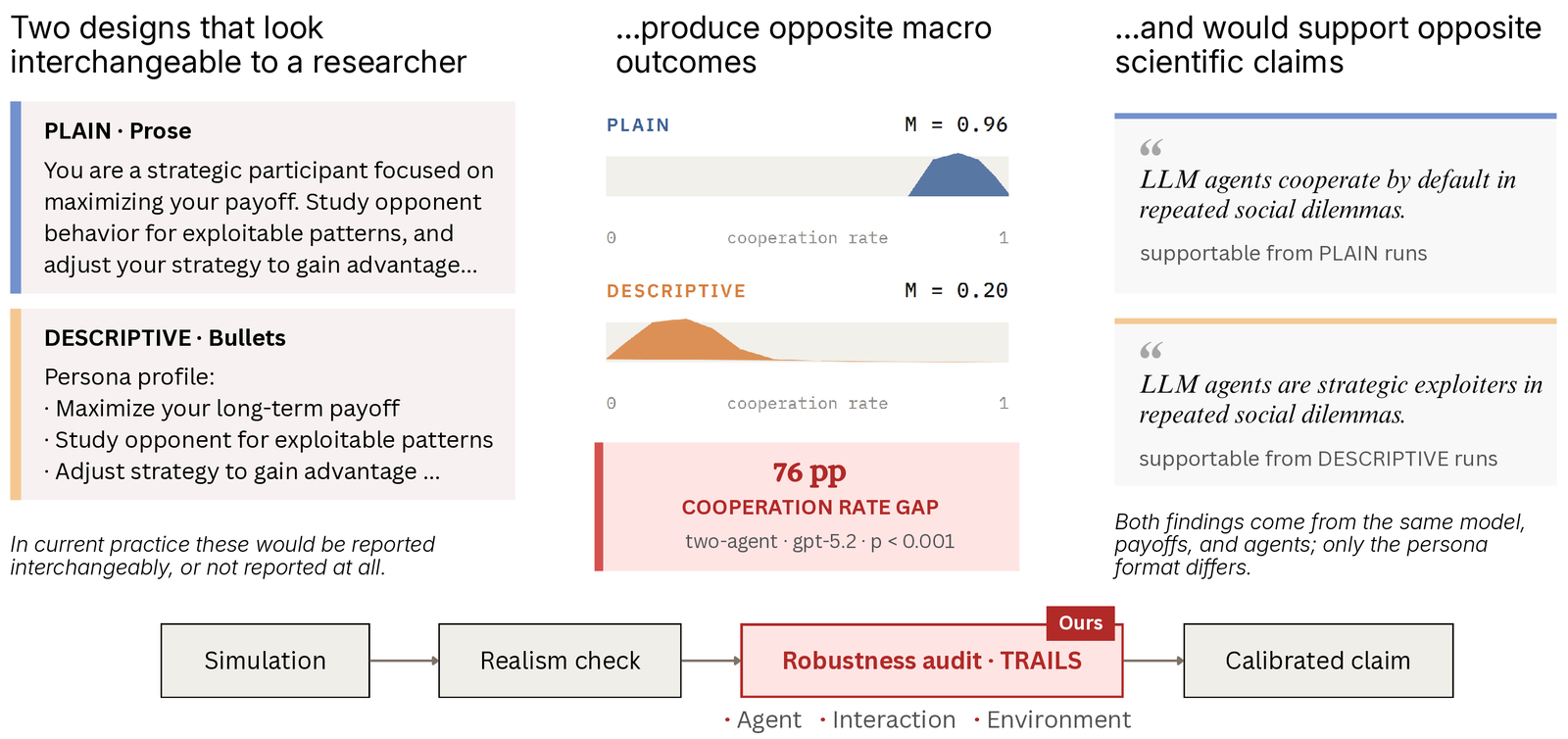 Stop Drawing Scientific Claims from LLM Social Simulations Without Robustness AuditsJinyi Ye*, Lei Cao*, Ding Chen, and Emilio FerraraNeurIPS 2026 Workshop on Large Language Models for Social Reasoning and Simulation (SocialAgent) (oral presentation), 2026
The scientific claims drawn from LLM social simulations should be no stronger than the robustness audits that support them. Generative agents bring new expressive power to agent-based modeling, enabling simulations of collective social processes like cooperation, polarization, and norm formation. Yet they also introduce complexity through additional architectural choices, such as agent specification, memory representation, interaction protocols, and environment design. Small perturbations that appear minor to researchers can cascade into macro-level outcomes through repeated interaction, creating a “butterfly effect.” Consequently, scientific claims drawn from LLM social simulations may reflect implementation artifacts rather than the social mechanisms being modeled. We support this position with two case studies: a repeated Prisoner’s Dilemma and a social media echo chamber simulation. Across multiple models, minor perturbations in persona format and game-instruction framing shift cooperation rates by up to 76 percentage points, while network homophily and hub assignment produce significant and consistent shifts in polarization metrics. We also find that sensitivity is unevenly distributed across both architectural choices and model families: the same perturbation that produces the 76 pp shift in one frontier model only shifts another by 1 pp. Robustness is therefore a property that should be measured per claim and per model, not assumed. To address this validation gap, we introduce TRAILS (Taxonomy for Robustness Audits In LLM Simulations), a robustness-audit taxonomy spanning three levels of simulation design: agent (micro-level), interaction (meso-level), and system (macro-level). We call for robustness to become a first-order validation requirement before LLM social simulations are used to explain mechanisms, evaluate interventions, or inform decisions.
@article{ye2026stop, title = {Stop Drawing Scientific Claims from LLM Social Simulations Without Robustness Audits}, author = {Ye, Jinyi and Cao, Lei and Chen, Ding and Ferrara, Emilio}, journal = {NeurIPS 2026 Workshop on Large Language Models for Social Reasoning and Simulation (SocialAgent) (oral presentation)}, year = {2026}, url = {https://arxiv.org/abs/2605.18890}, } - WWW 2026
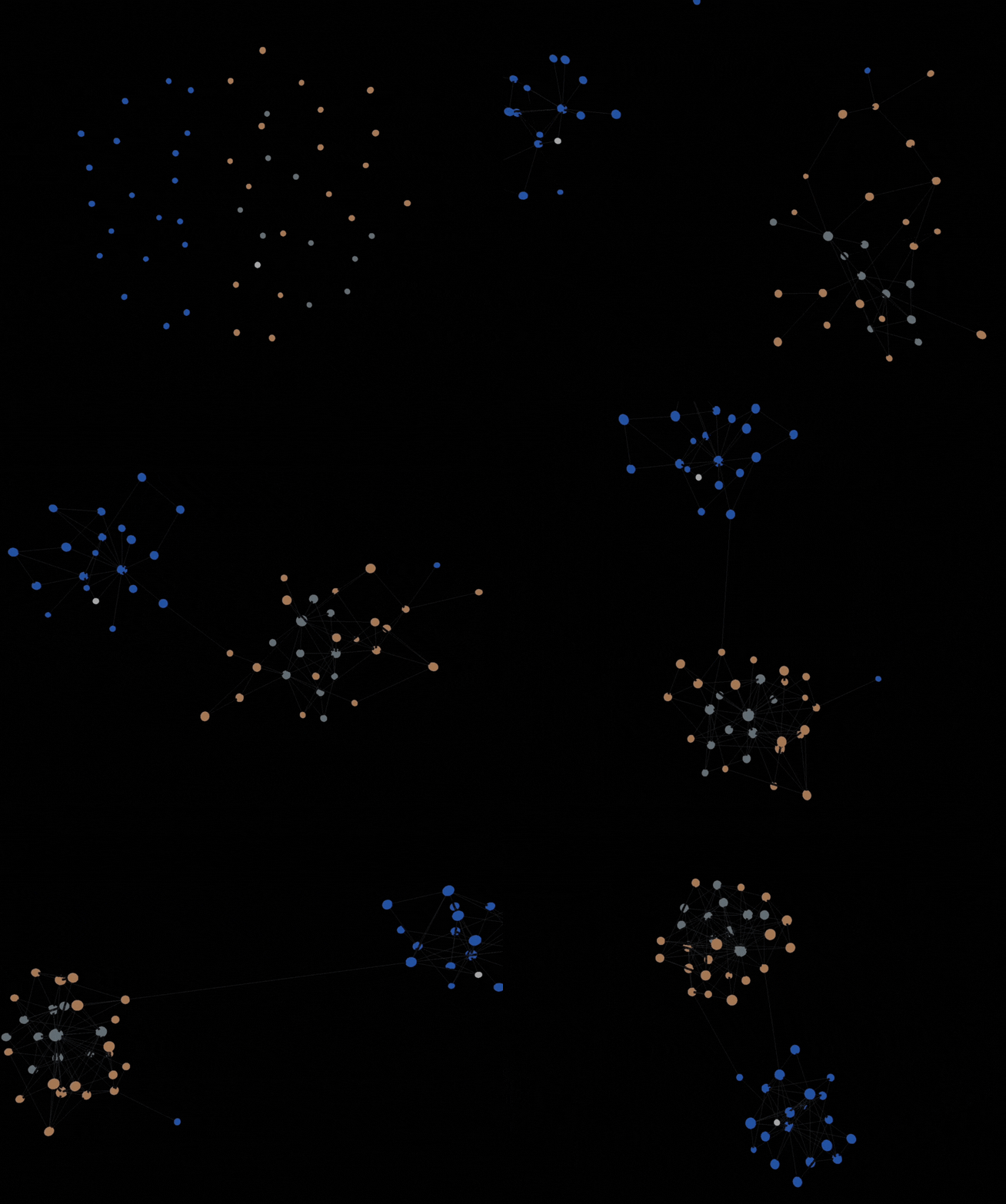 Emergent coordinated behaviors in networked LLM agents: Modeling the strategic dynamics of information operationsGian Marco Orlando*, Jinyi Ye*, Valerio La Gatta, Mahdi Saeedi, Vincenzo Moscato, and 2 more authorsProceedings of the ACM Web Conference 2026, 2026
Generative agents are rapidly advancing in sophistication, raising urgent questions about how they might coordinate when deployed in online ecosystems. This is particularly consequential in information operations (IOs), influence campaigns that aim to manipulate public opinion on social media. While traditional IOs have been orchestrated by human operators and relied on manually crafted tactics, agentic AI promises to make campaigns more automated, adaptive, and difficult to detect. This work presents the first systematic study of emergent coordination among generative agents in simulated IO campaigns. Using generative agent-based modeling, we instantiate IO and organic agents in a simulated environment and evaluate coordination across operational regimes, from simple goal alignment to team knowledge and collective decision-making. As operational regimes become more structured, IO networks become denser and more clustered, interactions more reciprocal and positive, narratives more homogeneous, amplification more synchronized, and hashtag adoption faster and more sustained. Remarkably, simply revealing to agents which other agents share their goals can produce coordination levels nearly equivalent to those achieved through explicit deliberation and collective voting. Overall, we show that generative agents, even without human guidance, can reproduce coordination strategies characteristic of real-world IOs, underscoring the societal risks posed by increasingly automated, self-organizing IOs.
@article{orlando2025emergent, title = {Emergent coordinated behaviors in networked LLM agents: Modeling the strategic dynamics of information operations}, author = {Orlando, Gian Marco and Ye, Jinyi and La Gatta, Valerio and Saeedi, Mahdi and Moscato, Vincenzo and Ferrara, Emilio and Luceri, Luca}, journal = {Proceedings of the ACM Web Conference 2026}, year = {2026}, url = {https://arxiv.org/pdf/2510.25003}, media = {https://www.washingtontimes.com/news/2026/mar/13/simulation-ai-agents-coordinated-propaganda-campaign-no-human-input/} } - NeurIPS 2026
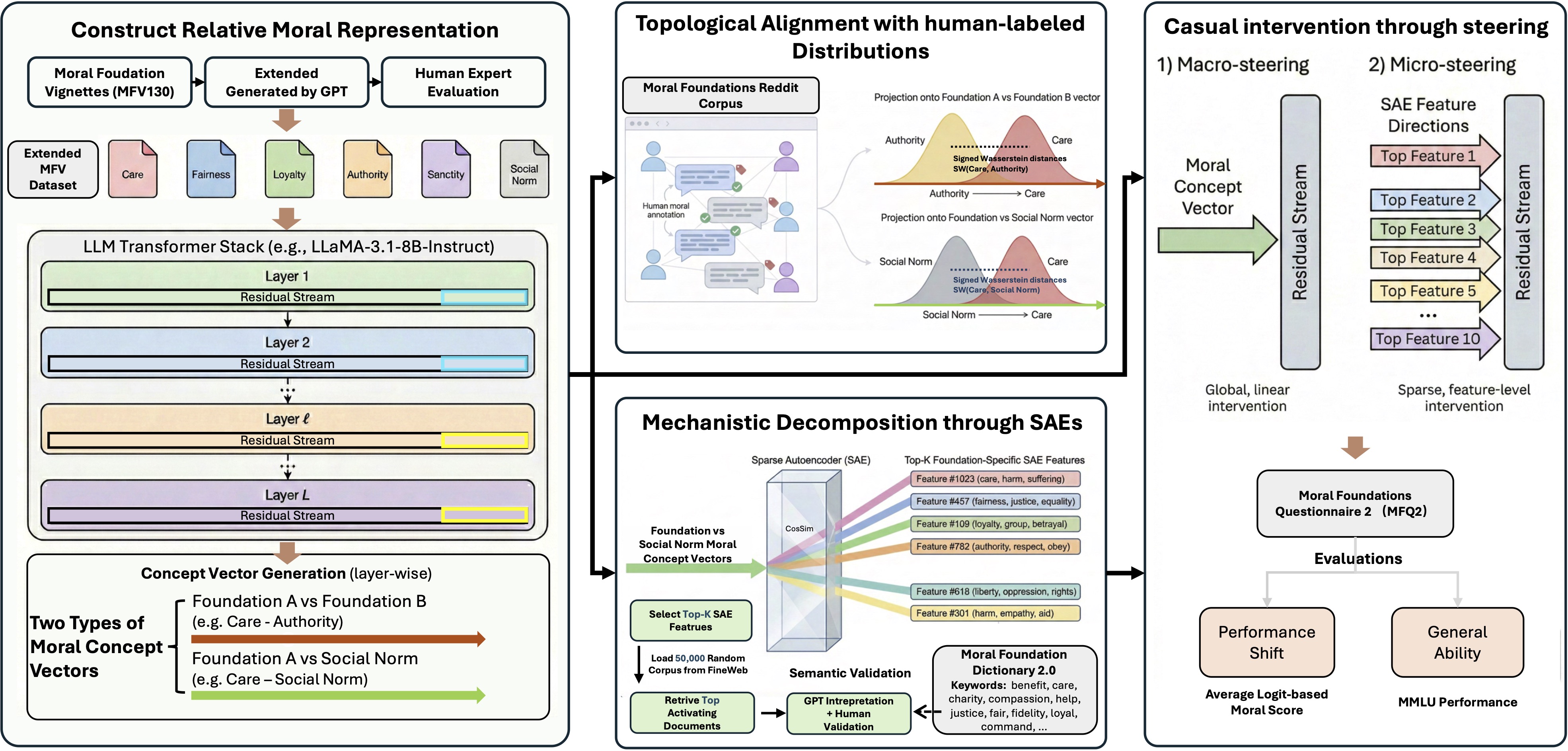 Tracing Moral Foundations in Large Language ModelsChenxiao Yu*, Bowen Yi*, Farzan Karimi-Malekabadi, Suhaib Abdurahman, Jinyi Ye, and 3 more authorsNeurIPS 2026, 2026
Large language models (LLMs) often produce human-like moral judgments, but it is unclear whether this reflects an internal conceptual structure or superficial “moral mimicry.” Using Moral Foundations Theory (MFT) as an analytic framework, we study how moral foundations are encoded, organized, and expressed within two instruction-tuned LLMs: Llama-3.1-8B-Instruct and Qwen2.5-7B-Instruct. We employ a multi-level approach combining (i) layer-wise analysis of MFT concept representations and their alignment with human moral perceptions, (ii) pretrained sparse autoencoders (SAEs) over the residual stream to identify sparse features that support moral concepts, and (iii) causal steering interventions using dense MFT vectors and sparse SAE features. We find that both models represent and distinguish moral foundations in a structured, layer-dependent way that aligns with human judgments. At a finer scale, SAE features show clear semantic links to specific foundations, suggesting partially disentangled mechanisms within shared representations. Finally, steering along either dense vectors or sparse features produces predictable shifts in foundation-relevant behavior, demonstrating a causal connection between internal representations and moral outputs. Together, our results provide mechanistic evidence that moral concepts in LLMs are distributed, layered, and partly disentangled, suggesting that pluralistic moral structure can emerge as a latent pattern from the statistical regularities of language alone.
@article{yu2026tracing,
  title = {Tracing Moral Foundations in Large Language Models},
  author = {Yu, Chenxiao and Yi, Bowen and Karimi-Malekabadi, Farzan and Abdurahman, Suhaib and Ye, Jinyi and Narayanan, Shrikanth and Zhao, Yue and Dehghani, Morteza},
  journal = {NeurIPS 2026},
  year = {2026},
  url = {https://arxiv.org/abs/2601.05437},
}
2025
- Preprint
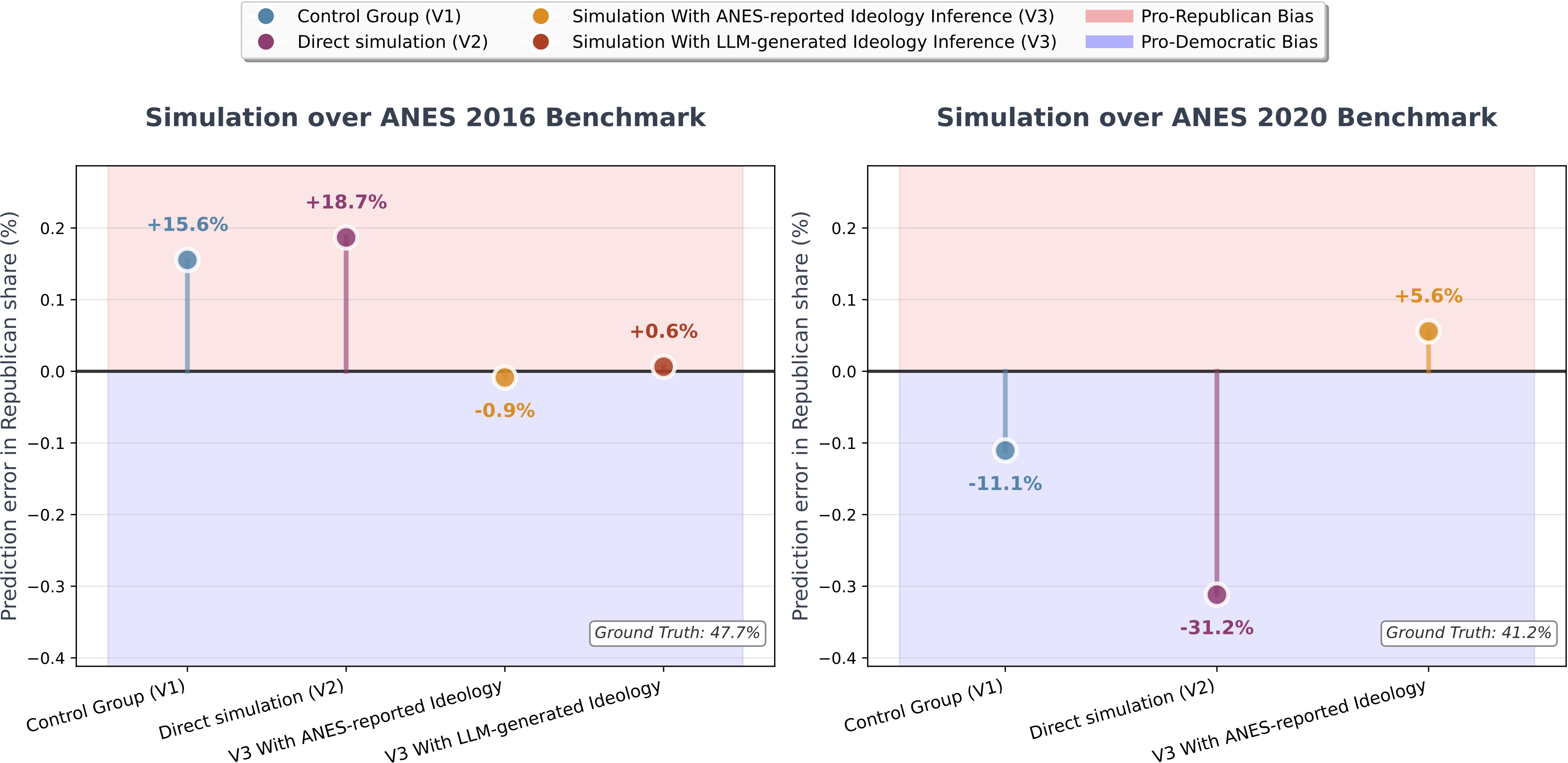 A large-scale simulation on large language models for decision-making in political scienceChenxiao Yu, Jinyi Ye, Yuangang Li, Zheng Li, Emilio Ferrara, and 2 more authorsarXiv preprint, 2025
Large language models (LLMs) are increasingly used as proxies for human behaviour in computational social science, yet their outputs often inherit biases from pretraining data and persona design, limiting their reliability. We present a theory-driven, multi-step reasoning framework that improves fidelity through latent variable inference, illustrated through ideology. The framework integrates demographic, ideological, and temporal factors and is evaluated on U.S. presidential election data. Comparing pipelines with and without latent variable inference, we find that anchoring simulated responses reduces partisan skew and improves alignment with real-world voting outcomes across three elections. At the same time, LLMs tend to flatten demographic structure and reduce within-group diversity. These findings show that latent variable anchoring offers a generalizable strategy for enhancing the reliability of large-scale LLM-based simulations of human decision-making, while emphasizing that LLMs should complement rather than replace human data within measurement–decision–aggregation frameworks.
@article{yu2024large, title = {A large-scale simulation on large language models for decision-making in political science}, author = {Yu, Chenxiao and Ye, Jinyi and Li, Yuangang and Li, Zheng and Ferrara, Emilio and Hu, Xiyang and Zhao, Yue}, journal = {arXiv preprint}, year = {2025}, url = {https://arxiv.org/abs/2412.15291} } - FAccT 2025
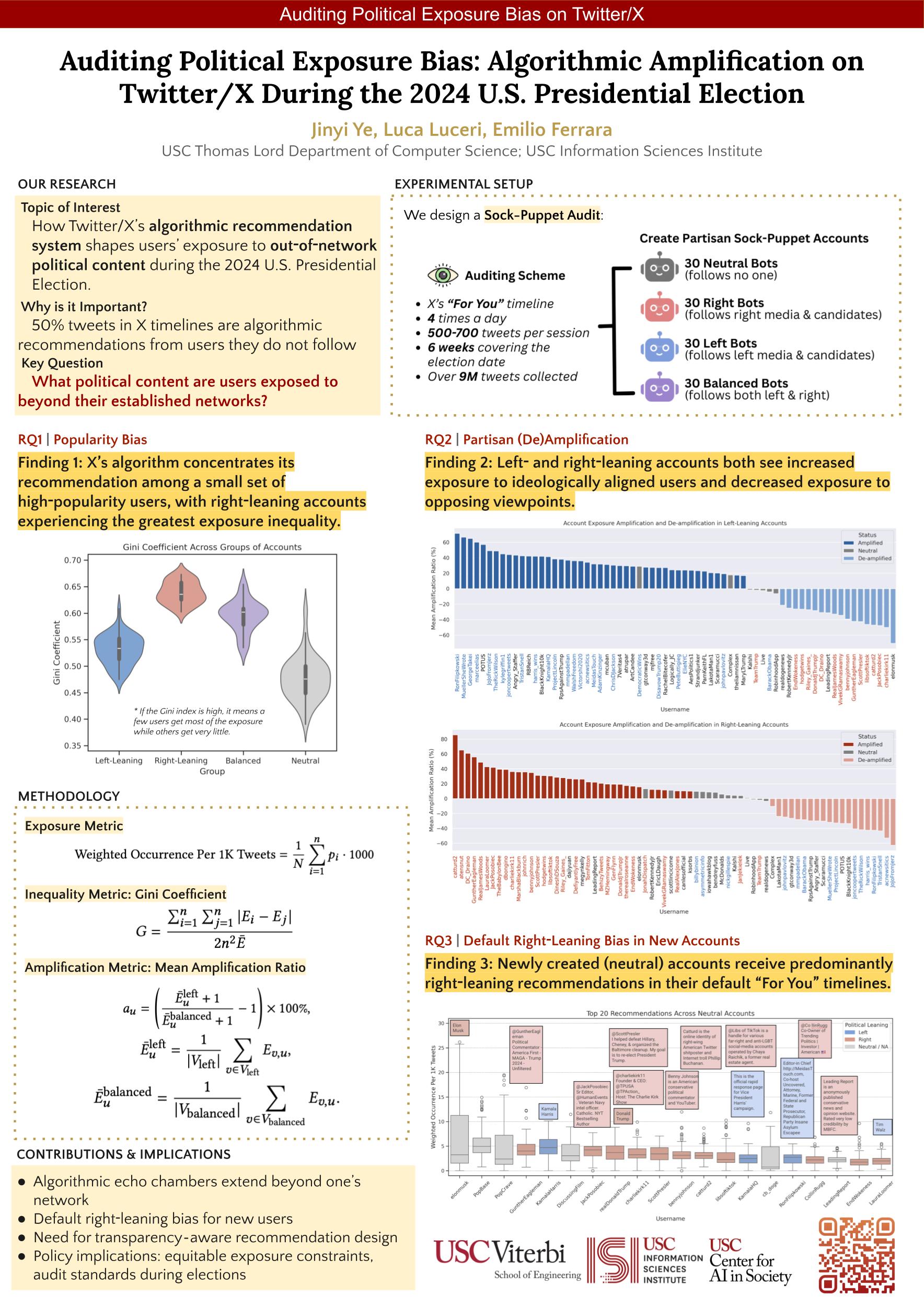 Auditing political exposure bias: Algorithmic amplification on Twitter/X during the 2024 US presidential electionJinyi Ye, Luca Luceri, and Emilio FerraraIn Proceedings of the 2025 ACM Conference on Fairness, Accountability, and Transparency, 2025🏆 Best Doctoral Poster Presentation, SHOWCAIS USC
Approximately 50% of tweets in X’s user timelines are personalized recommendations from accounts they do not follow. This raises a critical question: What political content are users exposed to beyond their established networks, and what implications does this have for democratic discourse online? In this paper, we present a six-week audit of X’s algorithmic content recommendations during the 2024 U.S. Presidential Election by deploying 120 sock-puppet monitoring accounts to capture tweets from their personalized “For You” timelines. Our objective is to quantify out-of-network content exposure for right- and left-leaning account profiles and assess any potential inequalities and biases in political exposure. Our findings indicate that X’s algorithm skews exposure toward a few high-popularity users across all monitoring accounts, with right-leaning accounts experiencing the highest level of exposure inequality. Both left- and right-leaning accounts encounter amplified exposure to users aligned with their own political views and reduced exposure to opposing viewpoints. Additionally, we observe that new accounts experience a right-leaning bias in exposure within their default timelines. Our work contributes to understanding how content recommendation systems may induce and reinforce biases while exacerbating vulnerabilities among politically polarized user groups. We underscore the importance of transparency-aware algorithms in addressing critical issues such as safeguarding election integrity and fostering a more informed digital public sphere.
@inproceedings{ye2025auditing, title = {Auditing political exposure bias: Algorithmic amplification on Twitter/X during the 2024 US presidential election}, author = {Ye, Jinyi and Luceri, Luca and Ferrara, Emilio}, booktitle = {Proceedings of the 2025 ACM Conference on Fairness, Accountability, and Transparency}, pages = {2349--2362}, year = {2025}, url = {https://dl.acm.org/doi/full/10.1145/3715275.3732159}, doi = {10.1145/3715275.3732159}, } - ICWSM 2025
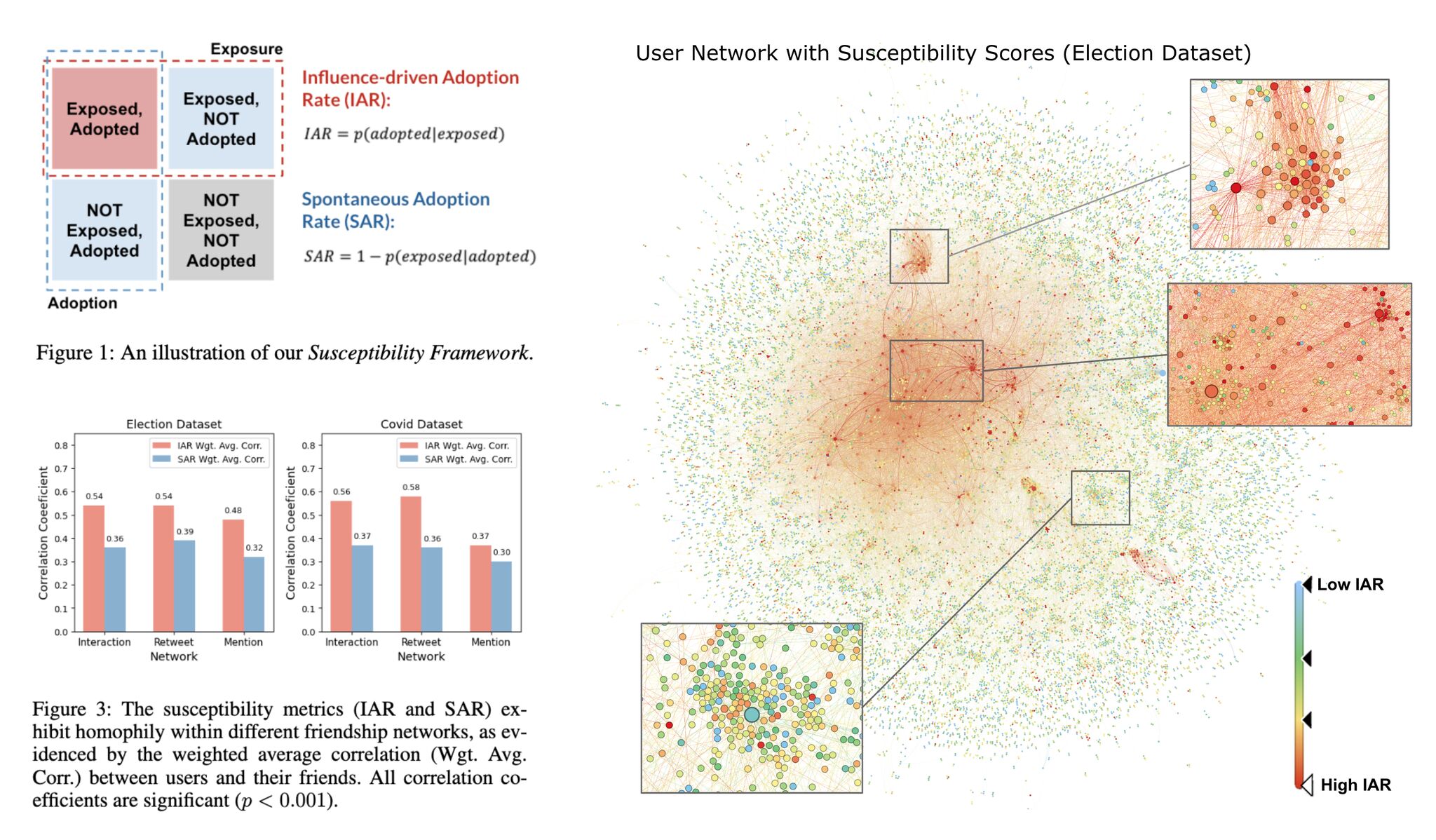 The susceptibility paradox in online social influenceLuca Luceri*, Jinyi Ye*, Julie Jiang, and Emilio FerraraIn Proceedings of the International AAAI Conference on Web and Social Media, 2025🌟 Best Paper Honorable Mention (Top 5 Papers)
Understanding susceptibility to online influence is crucial for mitigating the spread of misinformation and protecting vulnerable audiences. This paper investigates susceptibility to influence within social networks, focusing on the differential effects of influence-driven versus spontaneous behaviors on user content adoption. Our analysis reveals that influence-driven adoption exhibits high homophily, indicating that individuals prone to influence often connect with similarly susceptible peers, thereby reinforcing peer influence dynamics, whereas spontaneous adoption shows significant but lower homophily. Additionally, we extend the Generalized Friendship Paradox to influence-driven behaviors, demonstrating that users’ friends are generally more susceptible to influence than the users themselves, de facto establishing the notion of Susceptibility Paradox in online social influence. This pattern does not hold for spontaneous behaviors, where friends exhibit fewer spontaneous adoptions. We find that susceptibility to influence can be predicted using friends’ susceptibility alone, while predicting spontaneous adoption requires additional features, such as user metadata. These findings highlight the complex interplay between user engagement and characteristics in spontaneous content adoption. Our results provide new insights into social influence mechanisms and offer implications for designing more effective moderation strategies to protect vulnerable audiences.
@inproceedings{luceri2025susceptibility, title = {The susceptibility paradox in online social influence}, author = {Luceri, Luca and Ye, Jinyi and Jiang, Julie and Ferrara, Emilio}, booktitle = {Proceedings of the International AAAI Conference on Web and Social Media}, volume = {19}, pages = {1122--1138}, year = {2025}, url = {https://ojs.aaai.org/index.php/ICWSM/article/download/35864/38018}, media = {https://www.isi.edu/news/79167/why-your-friends-may-be-more-susceptible-to-influence-than-you-are}, doi = {10.1609/icwsm.v19i1.35864}, } - Hypertext 2025
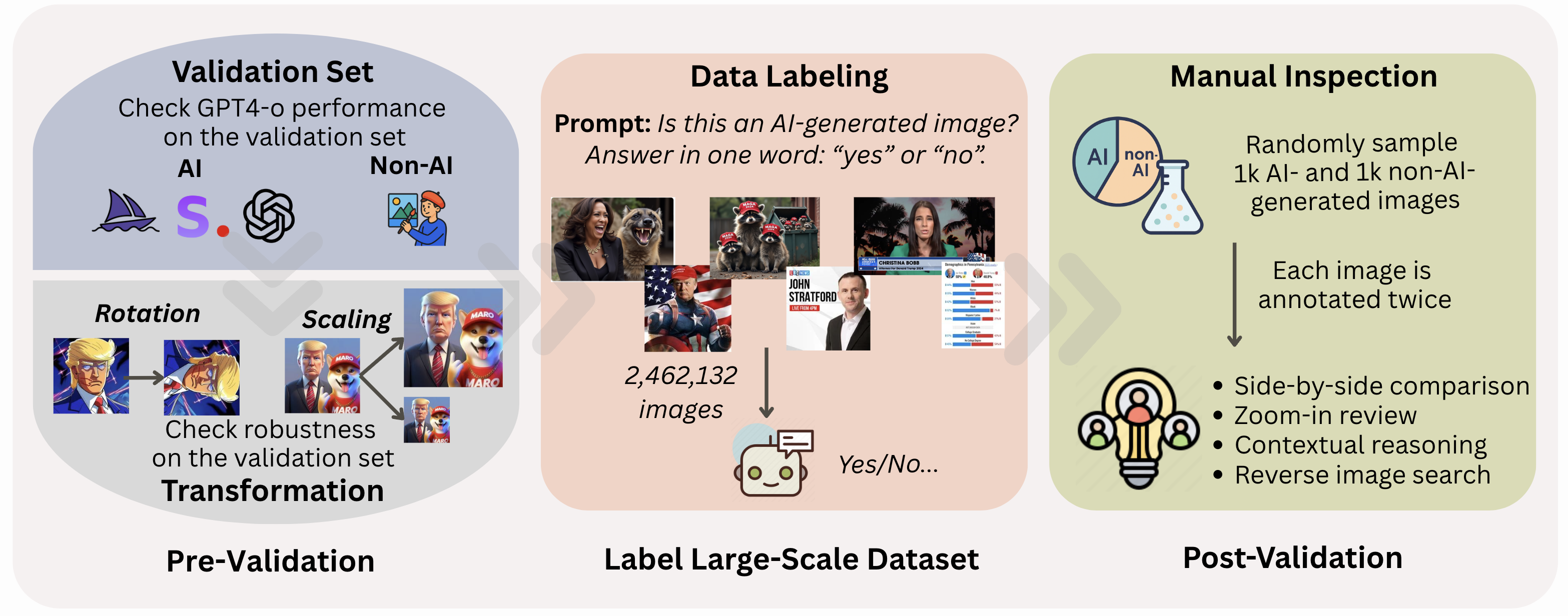 Synthetic politics: Prevalence, spreaders, and emotional reception of AI-generated political images on XZhiyi Chen*, Jinyi Ye*, Beverlyn Tsai, Emilio Ferrara, and Luca LuceriIn Proceedings of the 36th ACM Conference on Hypertext and Social Media, 2025🌟 Best Student Paper Honorable Mention
Despite widespread concerns about the risks of AI-generated content (AIGC) to the integrity of social media discourse, little is known about its scale and scope, the actors responsible for its dissemination online, and the user responses it elicits. In this work, we measure and characterize the prevalence, spreaders, and emotional reception of AI-generated political images. Analyzing a large-scale dataset from Twitter/X related to the 2024 U.S. Presidential Election, we find that approximately 12% of shared images are detected as AI-generated, and around 10% of users are responsible for sharing 80% of AI-generated images. AIGC superspreaders–defined as the users who not only share a high volume of AI-generated images but also receive substantial engagement through retweets–are more likely to be X Premium subscribers, have a right-leaning orientation, and exhibit automated behavior. Their profiles contain a higher proportion of AI-generated images than non-superspreaders, and some engage in extreme levels of AIGC sharing. Moreover, superspreaders’ AI image tweets elicit more positive and less toxic responses than their non-AI image tweets. This study serves as one of the first steps toward understanding the role generative AI plays in shaping online socio-political environments and offers implications for platform governance.
@inproceedings{chen2025synthetic,
  title = {Synthetic politics: Prevalence, spreaders, and emotional reception of AI-generated political images on X},
  author = {Chen, Zhiyi and Ye, Jinyi and Tsai, Beverlyn and Ferrara, Emilio and Luceri, Luca},
  booktitle = {Proceedings of the 36th ACM Conference on Hypertext and Social Media},
  pages = {11--21},
  year = {2025},
  url = {https://dl.acm.org/doi/full/10.1145/3720553.3746675},
  doi = {10.1145/3720553.3746675},
  data = {https://github.com/angelayejinyi/AIGC-Election-2024}
}
2024
- WWW 2024 (Oral)
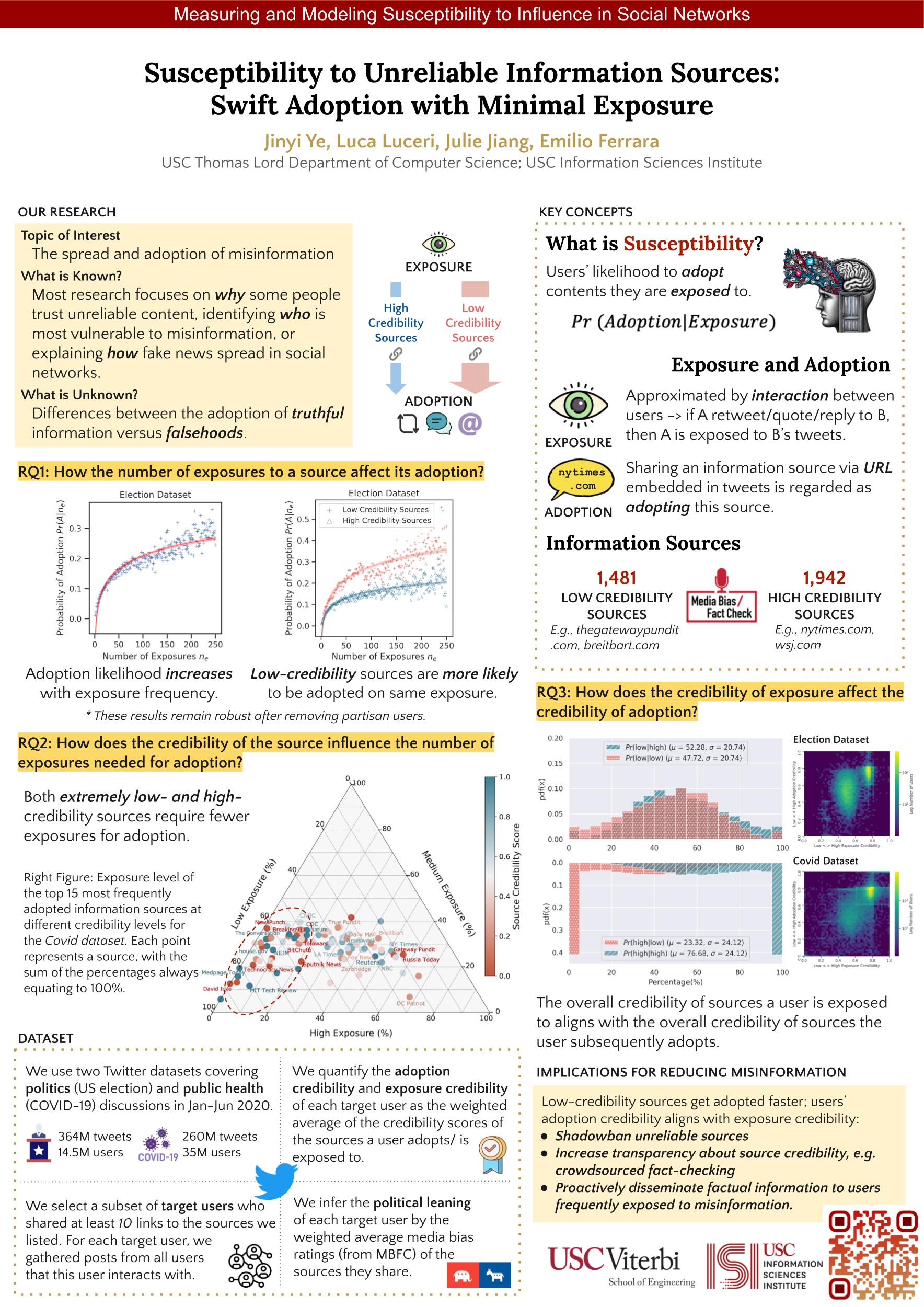 Susceptibility to unreliable information sources: Swift adoption with minimal exposureJinyi Ye, Luca Luceri, Julie Jiang, and Emilio FerraraIn Proceedings of the ACM Web Conference 2024, 2024
Misinformation proliferation on social media platforms is a pervasive threat to the integrity of online public discourse. Genuine users, susceptible to others’ influence, often unknowingly engage with, endorse, and re-share questionable pieces of information, collectively amplifying the spread of misinformation. In this study, we introduce an empirical framework to investigate users’ susceptibility to influence when exposed to unreliable and reliable information sources. Leveraging two datasets on political and public health discussions on Twitter, we analyze the impact of exposure on the adoption of information sources, examining how the reliability of the source modulates this relationship. Our findings provide evidence that increased exposure augments the likelihood of adoption. Users tend to adopt low-credibility sources with fewer exposures than high-credibility sources, a trend that persists even among non-partisan users. Furthermore, the number of exposures needed for adoption varies based on the source credibility, with extreme ends of the spectrum (very high or low credibility) requiring fewer exposures for adoption. Additionally, we reveal that the adoption of information sources often mirrors users’ prior exposure to sources with comparable credibility levels. Our research offers critical insights for mitigating the endorsement of misinformation by vulnerable users, offering a framework to study the dynamics of content exposure and adoption on social media platforms.
@inproceedings{ye2024susceptibility,
  title = {Susceptibility to unreliable information sources: Swift adoption with minimal exposure},
  author = {Ye, Jinyi and Luceri, Luca and Jiang, Julie and Ferrara, Emilio},
  booktitle = {Proceedings of the ACM Web Conference 2024},
  pages = {4674--4685},
  year = {2024},
  url = {https://dl.acm.org/doi/pdf/10.1145/3589334.3648154},
  doi = {10.1145/3589334.3648154}
}
2023
- ICWSM 2023
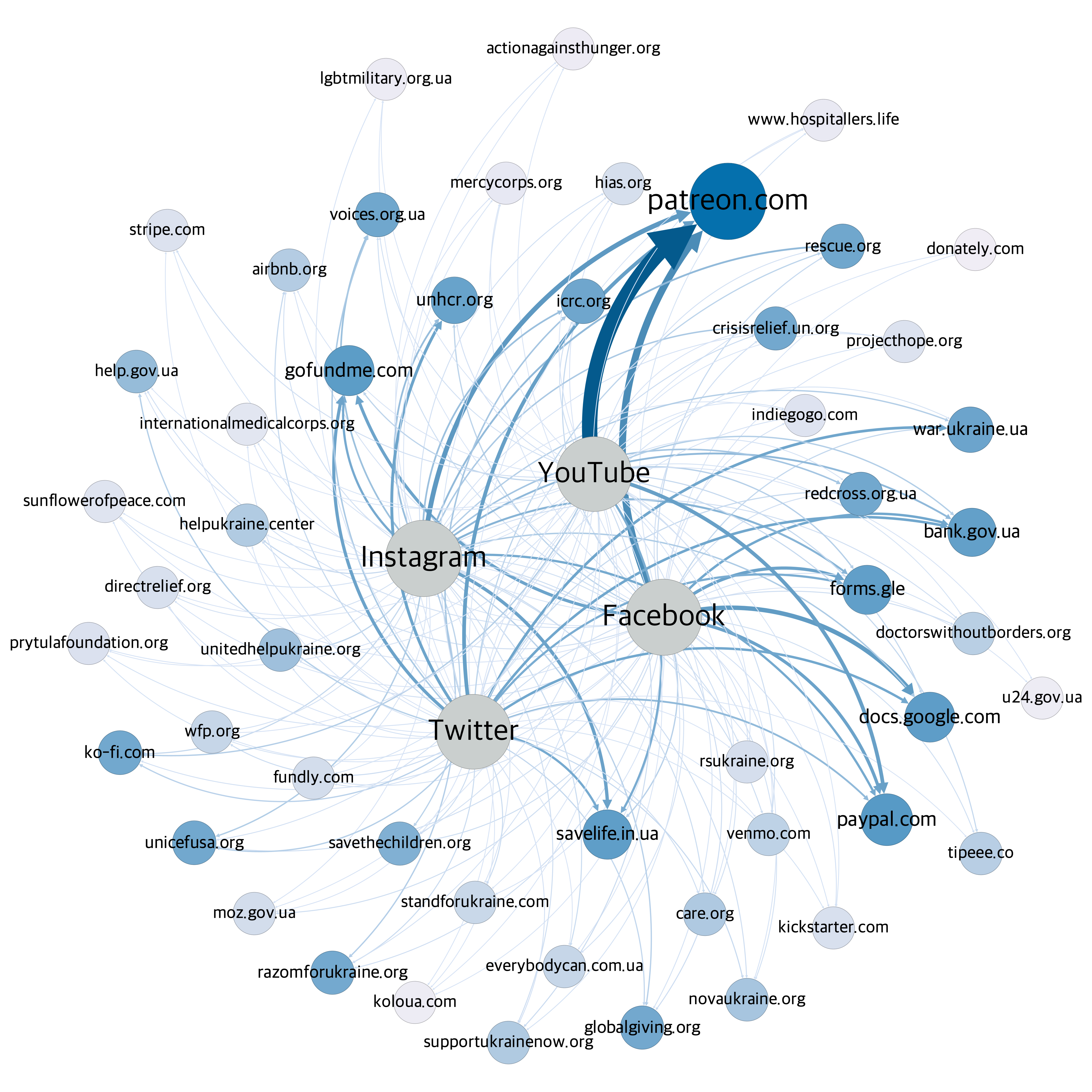 Online networks of support in distressed environments: Solidarity and mobilization during the Russian invasion of UkraineJinyi Ye, Nikhil Jindal, Francesco Pierri, and Luca LuceriICWSM Workshop on Data for the Wellbeing of Most Vulnerable, 2023
Despite their drawbacks and unintended consequences, social media networks have recently emerged as a crucial resource for individuals in distress, particularly during times of crisis. These platforms serve as a means to seek assistance and support, share reliable information, and appeal for action and solidarity. In this paper, we examine the online networks of support during the Russia-Ukraine conflict by analyzing four major social media networks: Twitter, Facebook, Instagram, and YouTube. Using a large dataset of 68 million posts, we explore the temporal patterns and interconnectedness between these platforms and online support websites. Our analysis highlights the prevalence of crowdsourcing and crowdfunding websites as the two main support platforms to mobilize resources and solicit donations, revealing their purpose and contents, and investigating different support-seeking and -receiving practices. Overall, our study underscores the potential of social media in facilitating online support in distressed environments through grassroots mobilization, contributing to the growing body of research on the positive impact of online platforms in promoting social good and protecting vulnerable populations during times of crisis and conflict.
@article{ye2023online,
  title = {Online networks of support in distressed environments: Solidarity and mobilization during the Russian invasion of Ukraine},
  author = {Ye, Jinyi and Jindal, Nikhil and Pierri, Francesco and Luceri, Luca},
  booktitle = {Workshop Proceedings of the International AAAI Conference on Web and Social Media},
  journal = {ICWSM Workshop on Data for the Wellbeing of Most Vulnerable},
  year = {2023},
  url = {https://workshop-proceedings.icwsm.org/abstract.php?id=2023_05},
  doi = {10.36190/2023.05},
  media = {https://viterbischool.usc.edu/news/2023/06/russia-ukraine-war-social-media-platforms-uplift-the-vulnerable/},
  data = {https://github.com/angelayejinyi/russia-ukraine-network-support}
}